This year the Legislature is considering a supplemental operating budget, which makes adjustments to the two-year state spending plan approved last April.
While state revenue projections came in slightly higher than expected, costs also increased — particularly in K–12 and higher education. Updated caseload forecasts added roughly $700 million in additional spending pressures. As a result, there is little to no new revenue available to restore cuts proposed earlier in Governor Ferguson’s budget.
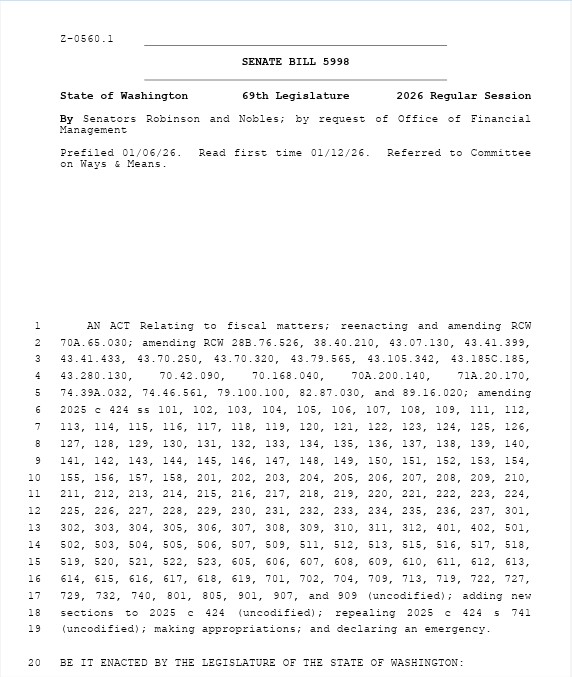
The House and Senate released their respective proposals Sunday afternoon with little public attention. The budget bills are HB 2289 and SB 5998. Public hearings were held on Monday Feb. 23 in the House Appropriations Committee and Senate Ways & Means Committee. Committee votes were scheduled for Thursday, Feb. 25.
Here’s what you need to know about these proposals:
K–12 Education
There are a few positive signs:
- Inflation-based wage increases for the 2026-27 school year were unchanged at 2.6%.
- Both budgets slightly increase funding for free school meals. (Senate=$3.2 million/House=$2 million)
- Neither budget makes additional cuts to paraeducator development funding.
However, both proposals reduce funding in several key areas outside of Basic Education. While these programs are not technically classified as “Basic Education,” cuts still impact students and school districts.
Transition to Kindergarten (TTK)
House: $18.9 million cut | Senate: $140 million cut
These reductions eliminate planned enrollment and funding increases scheduled to begin next school year.
Local Effort Assistance (LEA or “Levy Equalization”)
House: $25 million cut | Senate: $110 million cut
These cuts reduce enhancements that were intended to help property-poor school districts.
School Bus Depreciation
House: $21.1 million cut | Senate: $60 million cut
The proposals extend the amount of time it takes for the state to fully depreciate the cost of school buses from 8 to 10 years to 15 years, delaying full funding for new school bus purchases.
Running Start
House & Senate: $14 million cut
Running Start allows high school juniors and seniors to take college courses tuition-free while earning both high school and college credit.
PSE testified to the Appropriations and Ways & Means Committees that we oppose
cuts to Transition to Kindergarten, Local Effort Assistance, School Bus Depreciation, and Running Start. Any reduction in school funding — even outside of Basic Education — means fewer services and supports for students and greater financial instability for school districts.
Higher Education
PSE’s message to lawmakers has been clear: Preserve and protect funding for higher education, including restoring the integrity of the Workforce Education Investment Account (WEIA). For the most part, budget writers heard our message.
Both the House and Senate proposals are significantly better than the deeper cuts proposed in Governor Ferguson’s earlier budget. The Senate plan is slightly more favorable to higher education than the House proposal.
The Senate uses a complex financing strategy involving student fees, Workforce Education Investment funds, and long-term capital bonds to support university operations. While not ideal, this approach limits direct reductions to regional universities to approximately a 1.5% cut in administrative costs.
There’s no question the level of budget reductions to our regional universities could have been much worse.
Regional University Impacts
- CWU
- Senate: $165,000 administrative reduction
- House: $116,000 administrative reduction
- EWU
- Senate: $202,000 administrative reduction
- House: $202,000 administrative reduction
- WWU
- Senate: $311,000 administrative reduction
- House: $135,000 administrative reduction
At a time when our four-year public institutions are already operating lean, even administrative reductions create strain. However, compared to earlier proposals, these budgets avoid the most severe impacts.
As negotiations continue, PSE will advocate to protect funding for both K–12 and higher education. Cuts — even administrative, technical or “non-Basic Education” cuts — have real consequences for students, families, and school employees across Washington.